You bought a rental property to build wealth. You did everything “right” — researched neighborhoods, screened tenants, set rents at market rate. But three years in, something feels off. The cash flow doesn’t look like the spreadsheet you ran before closing.
You’re not alone. Most landlords discover the same hard truth: rental properties carry hidden costs that make the real returns far less impressive than advertised. Let’s break down exactly why — and what passive investors are doing instead.
The Real Math Behind Rental Property Returns
A $200,000 rental property renting for $1,800/month sounds like a 10.8% annual gross return. But gross is not what lands in your bank account.
Here’s what landlords actually deal with:
- Vacancy (5–10%): Even great properties sit empty between tenants. That’s $1,080–$2,160 gone every year.
- Property management (8–12%): If you hire out — and most investors eventually do — that’s another $1,728–$2,592 annually.
- Maintenance and CapEx (1–2% of value/year): Roofs, HVAC, plumbing surprises. On a $200K property, budget $2,000–$4,000 per year.
- Insurance, taxes, HOA: Easily another $3,000–$6,000/year depending on location.
- Tenant issues: Late payments, evictions, damage beyond deposit — these happen to every landlord eventually.
Net out those costs and a “10.8% gross” rental can shrink to 4–6% net — before your time, stress, or opportunity cost.
The Hidden Cost Nobody Talks About: Your Time
Rental properties are often called “passive income.” That’s a myth for most landlords.
Even with a property manager, you’re fielding calls, approving repairs, reviewing statements, handling insurance renewals, and eventually making decisions about selling or refinancing. Research suggests self-managing landlords spend 5–10 hours per property per month. At $100/hour, that’s $6,000–$12,000/year in time value on a single property.
That’s not passive. That’s a part-time job.
What Burnt-Out Landlords Are Discovering
Many experienced real estate investors eventually ask: Is there a way to get real estate-backed returns without the management headache?
The answer is mortgage note investing.
Instead of owning a property, you own the debt secured by a property. The borrower pays you monthly — principal and interest — just like they’d pay a bank. You’re not the landlord. You’re the lender.
No tenants. No toilets. No vacancy. No property manager to manage.
At TLC Property Partners, we co-invest in performing mortgage notes alongside passive investors. Our current portfolio returns over 8.5% annually — with zero defaults across 5 years and 8 active notes.
Rental Property vs. Mortgage Notes: A Quick Comparison
| Rental Property | Mortgage Note Co-Investing | |
|---|---|---|
| Management required? | Yes (even with PM) | No |
| Tenant risk? | Yes | No |
| Vacancy risk? | Yes | No |
| Monthly cash flow | Variable | Predictable |
| Typical net returns | 4–7% | 8%+ |
| Time commitment | 5–10 hrs/mo | Minimal |
| Accreditation required? | No | No (with TLC) |
Is Mortgage Note Investing Right for You?
Note investing is a great fit if you’re a landlord who’s tired of management headaches, an investor looking for predictable monthly income, someone with IRA funds looking for better returns than CDs or bonds, or a Colorado-based investor who wants real estate exposure without direct ownership.
It’s not for everyone — you won’t get appreciation on the property itself, and like any investment, notes carry risk. But for passive income and simplicity, notes are hard to beat.
Next Step
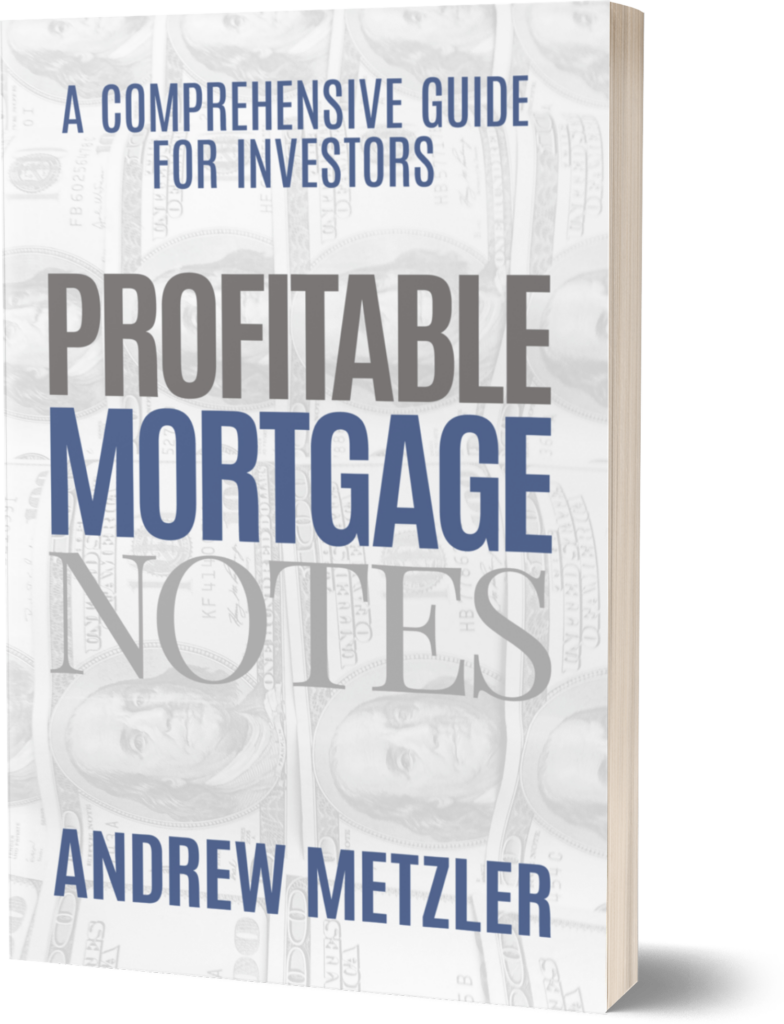
If you’re curious whether mortgage note co-investing makes sense for your situation, I’d love to talk through it. I’m Andrew Metzler, Managing Director of TLC Property Partners, a NoteSchool graduate, and a student of Eddie Speed — one of the nation’s foremost note investors.
You can reach out directly, apply to co-invest, or join the investor list to get updates on future opportunities.